
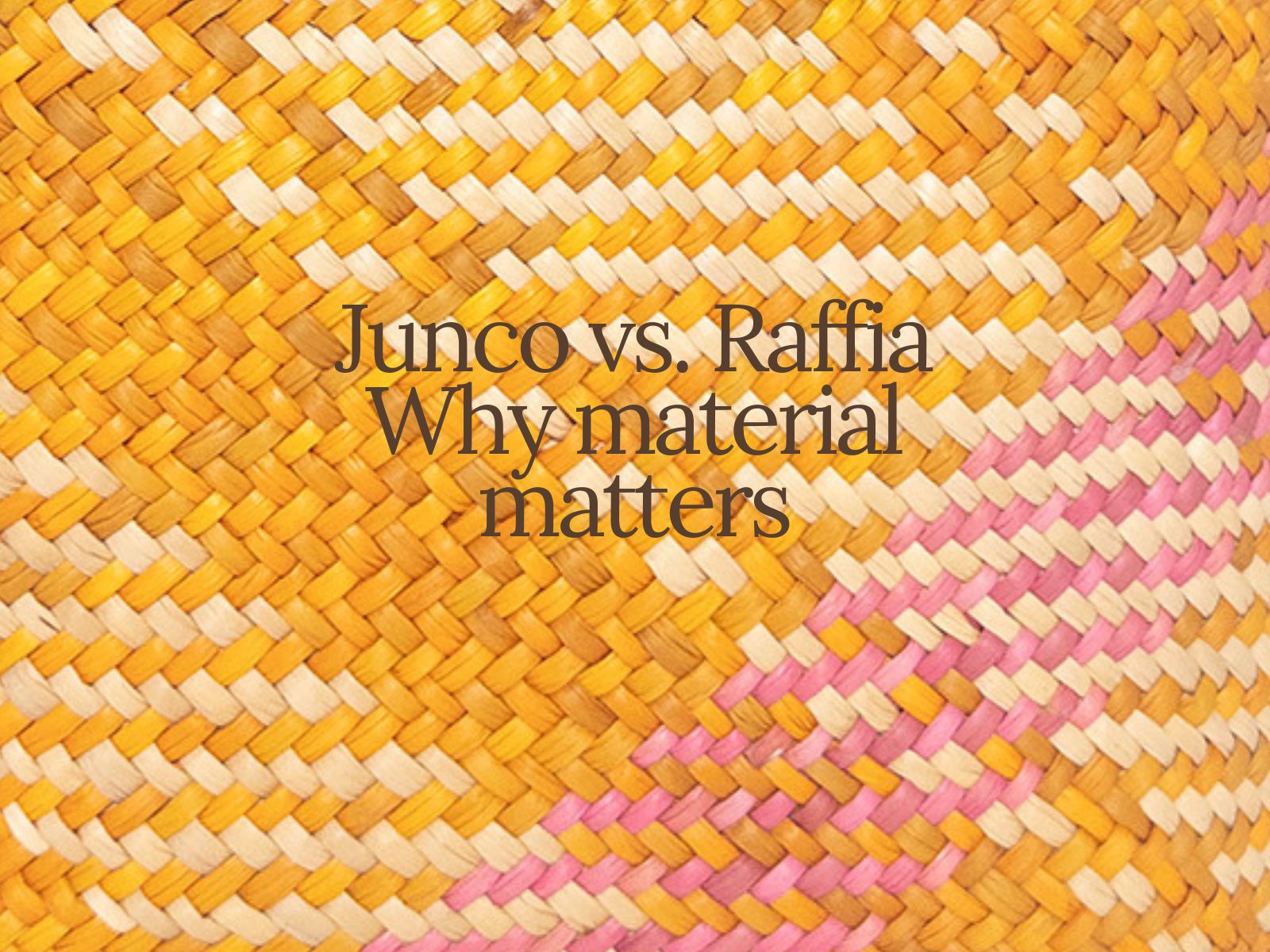
When people think of straw bags, raffia is often the first material that comes to mind. It has become synonymous with summer fashion and beach baskets around the world.
But raffia is not the only natural fibre used to create beautiful handbags — and in many cases, it is not the most durable one either.
At Orange Inca, we work primarily with junco, a natural reed from Peru that has been used by artisans for generations to create strong, lightweight baskets and accessories. It is a material that behaves very differently from raffia, and those differences are exactly what allow our handbags to last far longer than most straw bags.
If you have ever owned a raffia bag that started fraying after one season, you will immediately understand why the choice of fibre matters.
Let’s explore what makes these two materials different.

What Is Raffia?
Raffia is a natural fibre derived from the leaves of the raffia palm tree, which grows mainly in Madagascar and parts of Africa.
The long palm leaves are stripped into thin fibres, dried, and sometimes dyed before being woven or crocheted into accessories such as hats, baskets, and handbags.
Raffia is appreciated for its:
- Soft texture
- Lightweight feel
- Flexible weaving qualities
These characteristics make raffia easy to manipulate, which is why it is commonly used for crochet-style bags and summer hats.
However, that same softness can also be its weakness.
Because raffia fibres are relatively delicate, they tend to fray, split, or lose their structure with repeated use. Many raffia bags begin to show wear after just one season, especially if exposed to sun, sand, or moisture.
What Is Junco?
Junco is a natural reed that grows in the wetlands of northern Peru. Unlike raffia, which comes from palm leaves, junco grows as a tall, cylindrical plant similar to grasses or reeds.
Once harvested, the fibres are dried, cleaned, and then dyed using natural pigments before being woven by hand into baskets and accessories.
Junco has been used in Peru for centuries for both functional and decorative objects — from household baskets to storage containers and market bags.
What makes junco special is its combination of strength and flexibility.
The fibres are naturally sturdier than raffia, which allows artisans to weave bags that maintain their shape while still remaining lightweight and comfortable to carry.
This balance between durability and elegance is exactly what makes junco such a remarkable material for handbags.

Why Junco Holds Colour Better
Another major difference between raffia and junco is how the fibres absorb dye.
Because junco fibres are denser and smoother, they tend to absorb natural dyes more evenly and retain colour for much longer. This allows artisans to create rich, vibrant tones that remain stable over time.
Peru is also home to an extraordinary ecosystem where many natural dye sources grow abundantly. Artisans have access to a wide range of plants, roots, and minerals that allow them to produce an impressive spectrum of colours — from deep burgundy and navy to warm earthy neutrals and bright festival hues.
The result is a handbag that does not just look beautiful when new, but continues to maintain its colour and character as it ages.

Durability: The Real Difference You Notice
If you compare a raffia bag and a junco bag side by side, the most noticeable difference over time is durability.
Raffia bags are soft and charming, but they can lose their structure quickly. Fibres may loosen, edges can fray, and the bag may begin to sag after repeated use.
Junco behaves differently.
Because the fibres are naturally sturdier, they allow artisans to create tightly woven structures that hold their shape even after years of use.
Junco bags can also be gently reshaped if needed, as the fibres respond well to moisture without breaking — another characteristic that makes them remarkably resilient.
This durability is one of the reasons junco has traditionally been used for everyday baskets in Peru. These baskets were not decorative pieces; they were working tools meant to last.
Handwoven Craftsmanship Matters
Material is only part of the story.
The longevity of a handbag also depends on how it is woven.
At Orange Inca, our junco handbags are created by skilled artisans who have inherited weaving techniques passed down through generations. Each bag is woven entirely by hand, allowing the artisan to control the tension of every fibre.
This careful process creates a structure that is both strong and balanced.
Machine-made straw bags often lack this level of precision, which is why they can feel fragile even when made from natural materials.
Hand weaving, combined with the natural strength of junco, produces a bag that feels solid, structured, and reliable.

A Material That Supports Sustainability
Both raffia and junco are natural fibres, which makes them more environmentally friendly than synthetic materials.
However, junco offers additional sustainability advantages.
The plant grows naturally in wetland ecosystems and regenerates quickly after harvesting. Because it requires minimal processing and very little water compared to many textile fibres, its environmental footprint remains relatively low.
In addition, working with junco supports artisan communities that rely on traditional weaving techniques as a source of livelihood.
By choosing a handwoven junco bag, customers are not only selecting a durable accessory — they are also helping preserve centuries-old craftsmanship.
Why We Chose Junco for Our Handbags
For us, the decision to work with junco was deeply personal.
After travelling and collecting straw bags from many parts of the world, it became clear that nothing matched the strength, colour retention, and craftsmanship of the fibres used in Peru.
Junco allowed us to create bags that were:
- Lightweight enough for everyday use
- Strong enough to last for years
- Vibrant in colour thanks to natural dyes
- Beautifully handwoven by skilled artisans
It also allowed us to design bags that combine traditional techniques with modern functionality — features such as drawstring closures, durable straps, and carefully considered proportions.

The Beauty of a Bag That Ages Well
Perhaps the most satisfying thing about junco is how gracefully it ages.
Instead of deteriorating quickly, a well-made junco bag develops character over time. The fibres soften slightly, the structure adapts naturally to use, and the colours retain their richness.
It becomes a companion rather than a disposable accessory.
And in a world increasingly dominated by fast fashion, that kind of longevity feels more valuable than ever.
Discover Our Junco Handbags
Today, junco remains the heart of our handbag collection.
From the Playa, the design that inspired our journey, to the iconic Gran Fiesta Tote, each piece celebrates the beauty of natural fibres, artisan craftsmanship, and thoughtful design.
If you would like to learn more about the story behind this remarkable material, you can also read our main guide to handcrafted junco handbags.

Leave a comment
This site is protected by hCaptcha and the hCaptcha Privacy Policy and Terms of Service apply.